In the past few weeks two of my clients lamented about their experiences of political fatigue and divisiveness when we met.
She, an entrepreneur, told me that after reading my newsletter, “You’re being too political.”
As it turned out, she was sick and tired of the divisiveness, the tension, and didn’t know what to think or how to be with her own discomfort. More recently she shared, “I just try not to listen to the news.”
Another client told me that despite budget cuts and fundraising challenges in the far-reaching humanitarian nonprofit he runs, that it was “fine,” and that his team was “managing” with it all.
When I asked him how he was feeling, he paused, and genuinely looked at me as if I were speaking a foreign language. “I don’t know, tired I guess. I just try to hunker down and focus my attention.”
As we got deeper into it, he wasn’t simply tired, he was afraid, and wondering how he’d be able to keep his commitments.
I’m tired too: of the frenetic whipping up of emotion that spins out into the ether, only to resurface in stories that don’t reflect the realities at hand but do serve to keep the anxiety high and diffuse.
I struggle too, with acknowledging and harnessing my feelings, soothing myself to take some useful action.
Like the quaint storefronts the line the village squares of my youth, we tend to talk about our democracy like it’s a building, the foundation poured decades ago, with load-bearing walls and a roof that’s supposed to keep the weather out.
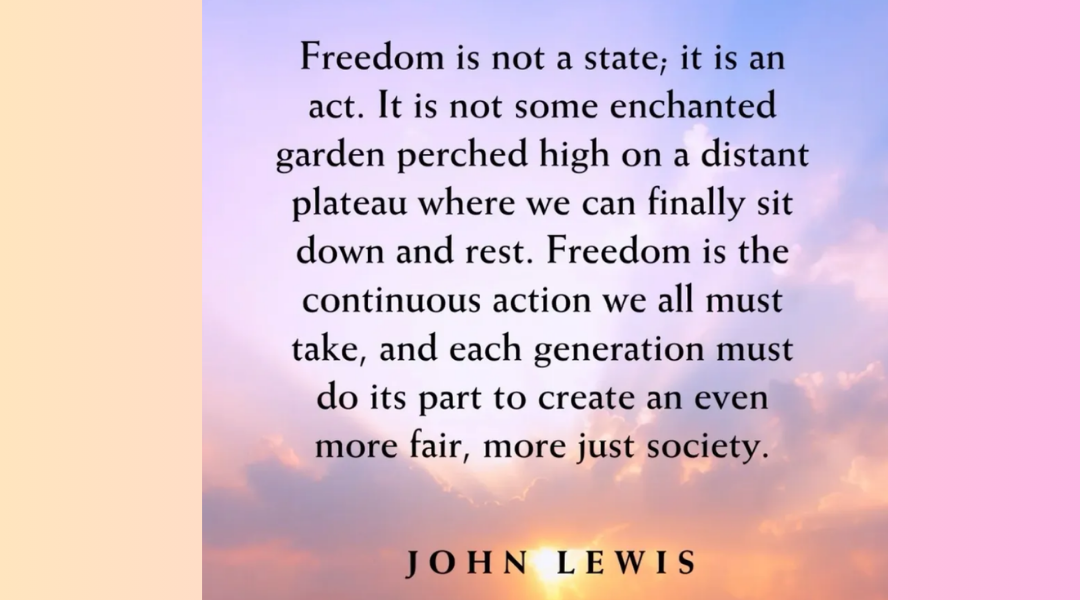
We think we just need to ‘do upkeep’ on democracy every few years. We vote and then go back to our lives. Of course, that’s never been true, and statesman John Lewis knew it better than almost anyone.
Freedom isn’t a structure we’ve inherited, but an act we repeat and one that requires actors capable of acting — not performing, or reacting, or defaulting to whatever the loudest voice in the room decided — but discerning what’s true and choosing accordingly.
Here’s an uncomfortable truth: the capacity to discern and choose isn’t primarily civic, it’s biological. And today, I’m concerned that a lot of us have quietly lost access to it.
The Infrastructure Nobody’s Checking
The jarring headlines of the nightly news mirrors back the enormous energy we spend debating the visible infrastructure of democracy: institutions, courts, norms, the mechanics of voting, etc.
Yet underneath it all there’s an essential piece of infrastructure nobody audits: whether we as the citizens of this operating system can still feel our way to our own values, or whether we’ve gone numb, unable to take action based on our values and concerns.
My clients knew what they cared about, but their fatigue generated by the ‘not-normal craziness’ was legitimately draining their capacity to feel the depth of their concerns and act from it fully.
Someone who can’t locate what they care about isn’t a discerning citizen, but a persuadable one. Not due to lack of intelligence but because the part of them that would normally do the discerning has gone offline, leaving a vacuum filled by whoever shouts the loudest or whatever algorithm manufactures outrage.
This is bad trouble at civic scale. It looks exactly like bad trouble at the individual scale, just multiplied: reacting on beliefs that defy reality, assuming everyone thinks like we do, difficulty paying attention long enough to think something all the way through and check that it syncs with our values.
Bad trouble results from felt-sense neglect, when folks stop being able to locate their own values clearly enough to hold them under pressure.

Why Bad Trouble Spreads
What worries me isn’t metaphorical, but basic biology: our nervous systems co-regulate.
The state of others around us — their tension, their calm, their reactivity — shapes our own nervous system, intended or not, and visa versa.
A leader who walks into a room dysregulated doesn’t just have a bad meeting. He transmits that state to everyone in the room, who then carries a version of it into their next room.
A country full of institutions run by people who’ve lost access to their own discernment doesn’t just produce bad policy, but citizenry trained, room by room, meeting by meeting, into a state disconnected from their own humanity . . . and it’s spreading like western wildfires.
This is why phrases like these, don’t hold up:
- “It’s not my job to fix the discourse.”
- “I just try not to watch the news.”
- “I try to hunker down and focus my attention.”
Our self-regulation, or lack of it, is contagious whether we consented to spread it or not. Protecting our own capacity to feel and discern isn’t self-indulgence in a moment like this one; it’s a public health necessity.
Listen to What You’re Saying
There’s a fast way to catch bad trouble before it becomes a habit: listen to your own language, it too is biological.
- “There’s nothing I can do.”
- “It’s hopeless.”
- “They get away with everything.”
These sound like descriptions of a situation, right? But, they’re not. They’re commitments, spoken into existence, that manufacture the very reality they claim to just be reporting on.
Say, “There’s nothing I can do,” enough times and you will, in fact, do nothing. Not because it was true, but because your language shaped that outcome.
The good news is that the same is true in the other direction.
- “Here’s what’s within my sphere of influence.”
- “I’m building a coalition instead of going it alone.
- “Taking small actions makes me feel purposeful.”
These aren’t merely positive affirmations to keep in your journal or paste on a wall. They’re different commitments, and different commitments produce different futures – for you, and for everyone whose nervous system is in the room with yours.
Attention is the First Act of Citizenship
If freedom is a continuous act rather than a state, the first act – every single time – is paying attention.
Not the ‘scrolling kind of attention’, but the kind that notices what you’re feeling before you decide what you think. The type of attention that notices what’s happening before you decide what it means to you.
This is not a small ask in a media environment engineered to fragment exactly this capacity, second by second, for profit.
Protecting our attention right now is not a self-care footnote, but a precondition for every other civic act that matters — voting with discernment instead of tribal reflex, speaking truth instead of repeating whatever arrived in your feed this morning, staying in relationship with people who see the world differently instead of writing them off before you’ve listened.
Lewis didn’t write “freedom is a continuous action” as poetry, but as an instruction.
Each generation does its part — not once, not by inheritance, but by doing the felt, attentive, discerning work that keeps the whole structure from becoming exactly the enchanted garden he warned us it would never be if we stopped tending it.
Often the work starts smaller than any of us want it to. It starts when we can still feel our way to what we truly believe, on a random Tuesday, before anyone else tells us what to think or feel.
It’s not being political, but principled. There’s a difference.
Everything else you do as a citizen gets built on top of that, or it gets built on nothing at all.
Reach me at dr*****@**********ng.com and tell me if you are still connecting with your values in all the noise. Have you been able to find a way to support democracy that supports you?
If you found this thoughtful and interesting, please forward to a friend.
_____________________________________________
A Leadership Pause Book of Practices Book Club
If you’re ready to dial in your focus, up your awareness for greater impact, join me in the Book Club.
It’s 5 weeks,5 sessions for one hour, with one goal: To make pause a practice – together.
We’ll meet after work from 4-5 CT via Zoom starting Thursday October 1st and completing on Thursday October 29th, 2026. Link to sign up: https://forms.gle/t6HVk5rqGgd7Pe4TA