Back in the spring of 1992, I went on a girl’s trip to Czechoslovakia and had a history lesson.
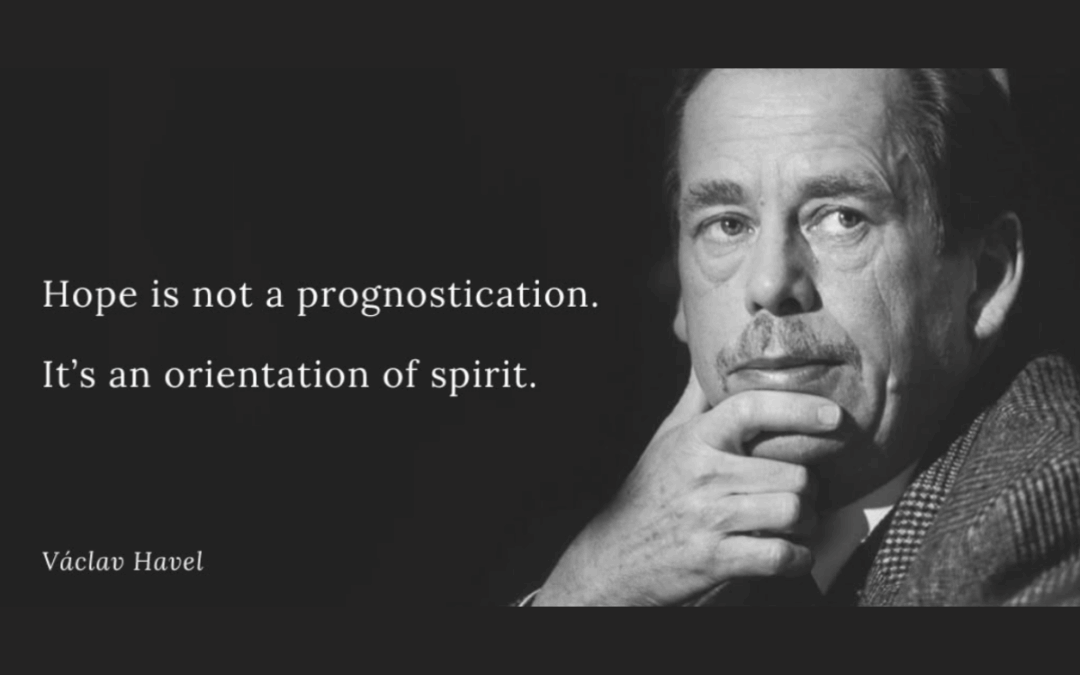
Just three years prior, in 1989, Vaclav Havel, a playwright and activist who wrote widely about the challenges of the communist reign, had been released from prison after years of confinement for voicing his concerns.
Within months, the communist regime had collapsed, and he was president of a free, democratic country.
Nobody had predicted it. Not the CIA, not Soviet leadership, and certainly not even Havel himself.
But in the years leading up to what came to be called the Velvet Revolution, he’d kept writing, challenging, enrolling others to take a stand despite all odds. The city was alive; people were friendly and eager.
Years later, someone asked him about hope — how he’d sustained it through everything.
Havel’s answer has stayed with me:
“Hope is not the conviction that something will turn out well, but the certainty that something makes sense, regardless of how it turns out.”
Read that again slowly. The certainty that something makes sense.
Today, a lot of things in the US don’t make sense. Disruptions, chaos, and craziness continue to escalate, unsettling our collective nervous systems. I’ve been sitting with Havel’s words this summer. How do we hold out hope? What are we to do?
It’s alongside a question that surfaced in the Still In It report released this spring: what are the leaders who are navigating this moment most gracefully doing differently than the rest of us?
They’re not more informed, nor do they have better answers. What they do have is more stable ground to stand on.
That’s it. That’s the whole thing.
And when I trace what that stable ground is made of, I keep arriving at the same place: attention. Not just managing it or protecting it from distraction but reclaiming it as a creative force. Like Havel did.
So too, Father Richard Rohr who recently shared, “As long as we’re in honest and loving relationship with what is right in front of us, the Spirit can keep working in us, through us, and for us.”
Training and attending to our attention, as I’ve been saying to clients lately, is the most important leadership asset we have.
And research backs this up: nature restores attention, deep rest restores attention, meaningful human connection restores attention. Real conversations — not just brief check-ins, but curious questions and listening — restore our attention.
You already know what depletes your attention: The firehose of incoming blither called news, the algorithmically optimized scroll, the low-grade dread about the size and scope of changes to our economy, and our way of life that’s become so ordinary we’ve stopped noticing. Not good.
Is disengaging from all of it avoidance?
I’ve dialed down how much I take in news wise, in an attempt to address what I now believe was misguided notion: staying glued to every breaking development was a form of responsibility, even care, because looking away was a kind of privilege that draws down energy.
But here’s what I want to offer today instead: protecting our attention is not withdrawal. It is reclaiming our most powerful creative force, our consciousness. That very thing that makes leadership, the kind that creates something new rather than just reacting to what’s there, possible.
Neuroscientist, Clayton Aldhern, writing about the “direct interventions” of our current environment on our physical brains, argues that we’re becoming measurably more suspicious, more anxious, more distracted due to climate change. Climate change lives inside each of us, not just out there, shaping our neurobiology in ways we’re only beginning to understand.
That’s not a metaphor. It’s a physiological reality, and it has long range of consequences. When our nervous systems are running in fight-or-flight, the prefrontal cortex — the seat of wisdom, perspective, and creative problem-solving goes offline.
We’re not just stressed. We’re temporarily less capable of the kind of thinking leadership requires.
And, when we’re off-center, our nervous system transmits that jangled energy to our team and anyone else we’re with. We broadcast a signal, whether we intend to or not, that either settles or amplifies the people around us. Powerful.
So, the question isn’t whether protecting our attention matters. It’s whether we’re willing to treat it as seriously as it deserves.
Havel’s hope wasn’t passive
Vaclav didn’t wait in his prison cell for things to improve. He wrote, he organized and stayed in conversations with the people around him. He acted from a deep sense that what he was doing made sense, even without knowing how it would end.
The leaders I spoke with this spring are doing something similar. Not all of them would describe it this way. But when I look closely at what distinguishes those who are leading with the most grace, it’s a kind of active settledness. A willingness to keep going without the comfort of a clear ending.
One of them, a filmmaker, put it this way: “What we need to be investing in right now are the networks, the relationships, the systems that can create what’s new once this moment passes.” He wasn’t resigned, but oriented.
Facing the uncertainty head-on and asking: given this, what makes sense to build?
That’s Havel’s hope. Ours too if we claim it.
The practice underneath all of this
It starts small, deliberately small. Not as a technique for getting through the day, though it helps with that too, but a genuine reorientation of where you put your attention, and why.
A ten-minute walk without a podcast. Lunch somewhere with a window you can look out. A conversation where you’re not composing your response while the other person is still talking.
These aren’t indulgences but maintenance. You can’t drive a car indefinitely without stopping for fuel, and you can’t lead your life indefinitely without restoring the attention that makes life and leadership possible.
The Still In It report confirmed what I’ve seen in years of working with folks: the ones holding steadiest aren’t the ones with more information, more resources, or better strategies. They’re the ones who’ve built practices that return them to themselves.
They’ve found their equivalent of what I found as a kid; pressing my hand against the bark of an old bur oak at the end of our driveway, feeling something in me begin to settle.
The tree wasn’t a metaphor. It was a resource. The settledness wasn’t in my head; it was in my breathing, my chest, my whole body.
That’s what we’re protecting when we protect our attention: our capacity to be present to the realities of the moment. To ourselves, to the people we lead, to the moment as it actually is, rather than the story we’re spinning about it.
We don’t know how this story ends
Neither did Havel.
What we have is what he had: the certainty that what we’re doing makes sense, and the choice — made again, every day, in small, repeated acts — to keep showing up from the most grounded version of ourselves we can access.
Grounded in values, in what we care most about, as a generative process. That’s not a small thing. That is, in fact, the whole thing.
Reach me at dr*****@**********ng.com and tell me what brings you hope right now. For me, it’s my garden and time with people whom I love.