This summer the USA turned 250. Given the degree of unsettledness, disruption, and chaos that continues to escalate, I wasn’t sure how to best participate in any sort of celebration or what to pay attention to.
We ended up choosing to watch a broadcast built around our 250th anniversary and an image from it stayed with me. Here’s the link, listen from 3:30 – 21:30.
On the night Thomas Jefferson finished the sentence that would define this country – “we hold these truths to be self-evident that all men are created equal.” – a 14-year-old light-skinned slave named Robert Hemings was in the room with him.
Hemings brought Jefferson tea and made sure he wouldn’t be disturbed as he wrote. Robert couldn’t read the words he was writing, nor could he possess the rights they promised. He was, by the law of that room, the personal property of Jefferson. Yet he was present.
That opening scene is not a footnote, at all. It reveals something about attention that most of our anniversary talk skipped right past: democracy was never a finished thing that we’re failing to live up to.
It was, from its first sentence, a promise written faster than it could be kept.
The gap between the sentence and the person in the room, Robert Hemings, is not a flaw in the American story. It is the American story, repeating itself in different rooms, with different names, for 250 years.
When I reflect on what deserves our attention right now, at this particular hinge point in history, I don’t think the honest answer is optimism or despair at all.
I think it’s the gap itself that holds the key.
It’s the gap wherein the famed sentence, “we hold these truths to be self-evident that all men are created equal,” still outruns the person in the room.
The gap holds the key.
Think about the keys in your life for a moment, literally. Maybe go find your keys in your bag or hanging next to your door.
Hold them in your hand, simply noticing the weight, the small cold edges, the ordinary fact of them and what they allow you to do each and every day.
Values Live in the Body, Not in the Mission Statement
What many years of sitting with people’s nervous systems has taught me, and there are many lessons, is that we can know our values, reclaim them from our first family for ourselves, recite them fluently, and yet still not live into them fully.
Values that haven’t dropped into the body are just vocabulary.
They’re simply a story we tell about ourselves, not a felt commitment our biological system will act upon under pressure.
The people in that broadcast we watched last month, whose long-forgotten names now sit in history books, weren’t just reciting values; they were living them. Embodied values, living in their bones, in their choices.
Amelia Boynton Robinson spent thirty years registering Black voters before she was beaten unconscious on a bridge in Selma, Alabama. Fifty years later she crossed that same Edmund Pettus Bridge again, at 104, pushed by the country’s first Black president.
A 17-year-old named Darnella Frazier didn’t have a mission statement. She had a phone, and a nervous system that held steady enough to keep recording for nine minutes and 29 seconds, when all she wanted to do was look away as George Floyd’s life was choked out of him.
On the first floor of the United States Capitol, on January 6th, 2021, a police officer, Eugene Goodman stood alone, facing a mob. He had passed Senator Mitt Romney in a corridor and directed him to safety. But then he stood alone. He understood what was at stake as the mob advanced.
Eugene Goodman went up the stairs, drawing the mob after him, making himself the target, leading them away from the Senate chamber, which was still full of legislators who had not been evacuated, toward a place where the mob could be contained. He bought enough time: one man, one staircase, one decision made in seconds.
These are what full-bodied values look like under load. When we reflect, rehearse, and practice our values they become embodied. So then, when a challenging (or even frightening) moment arrives, we too can take the next right action step like Amelia, Darnella, and Eugene.
What are your values revealing to you in your body right now, today, at this inflection point in our history?
Not the values you espouse or politely share at events or host on a website, but the ones your shoulders, breath, and gut intimately know.

What We Owe Each Other
There is real trauma held in this country, at the individual level, the family level, and the collective level, layered on top of itself for generations. It’s alive and lives in the gap; it deserves to be addressed.
Yet for now, I can say that healing on such a scale is never a solo act. It can’t and was never meant to be. Which brings me to the keys.
What Tomas Held, What You’re Holding
In November of 1989, in the freezing cold on the square in Prague, a 19-year-old named Tomas Hovlachek reached into his pocket and took out his keys. Holding them over his head and began to shake them, and then the person next to him did the same, and the person next to her.
Within minutes, hundreds of thousands of keys were ringing through the dark, an entire city telling a government it no longer believed in, using the most ordinary object any of them owned.
Not a weapon, not permission. Just an everyday item already in their pockets and turned them into a sound loud enough to be heard across the land.
Within 30 days, the playwright, who had been imprisoned for the crime of writing words his government didn’t like, became the first freely elected president of the Czech Republic.
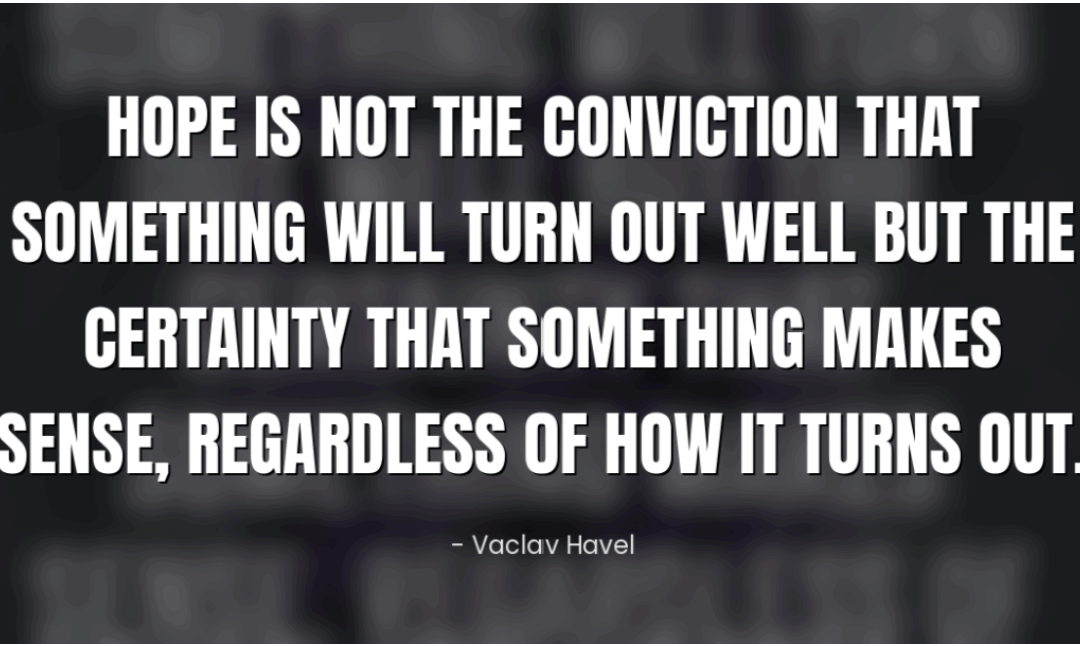
Vaclav Havel didn’t become a leader because he had more power than anyone else in that square. He got there because enough ordinary people decided their one small key, used together, was enough.
It’s the power to show up in the gap that mattered most.
Reach me at dr*****@**********ng.com and tell me if your values are showing up ways you intend. Have you considered how to use your key, to take one action to fill a gap.
If you found this thoughtful and interesting, please forward to a friend.